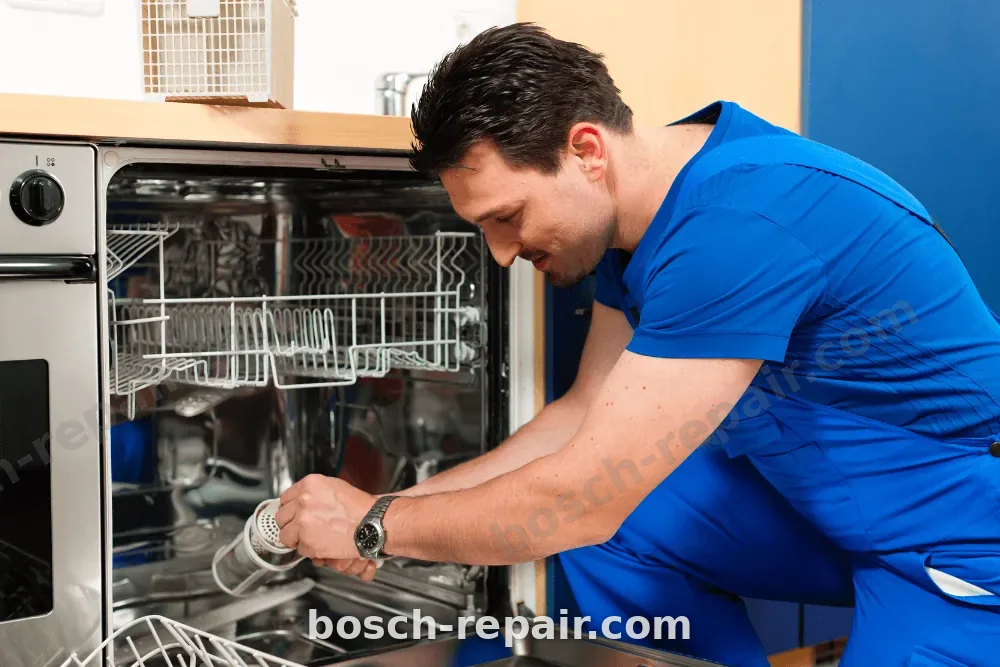
Bosch Dishwasher Repair in Dubai
A technician can diagnose most Bosch dishwasher faults at your home in under an hour and give you a fixed price in AED before any work starts. Book before 4 pm and most areas of Dubai get a visit the same day. Nearly every call falls into one of eight symptoms: water left in the base, no start, no fill, no heat, a leak, poor cleaning, noise, or a door that will not latch. This page covers each one, what usually causes it, what you can safely check yourself, and where to stop.
We are an independent Bosch appliance repair company, not the manufacturer. If your dishwasher is still inside Bosch's warranty, contact Bosch first. Our independent service center page explains how to decide.
At a glance
- Inspection and written quote: AED 99, deducted from the repair if you go ahead
- Typical repair ranges: AED 160 to 540, excluding 5% VAT
- Warranty: 90 days on parts and labour for the repaired fault
- Hours: every day, 7 am to 10 pm, by WhatsApp or online booking
Bosch dishwasher repair: what we fix and which models
We repair Bosch dishwashers in homes across Dubai: 60 cm and 45 cm models, freestanding and fully integrated, from the Serie 2 to the Serie 8. That includes models sold with the Silence Plus and Super Silence labels, which describe how quiet the machine is.
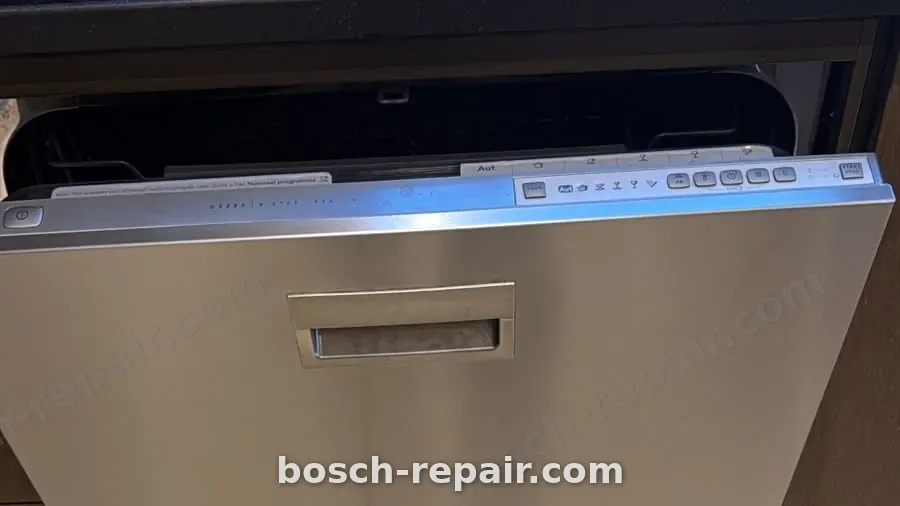
The series number tells you the feature level, not the parts inside. Two Serie 4 dishwashers with different model numbers can use different pumps, heaters and control modules. The number that matters is the E-Nr on the rating plate, a sticker that is usually on the edge of the door or the inner side panel when you open it. Photograph it before you call. With the E-Nr, a technician can check part availability before the visit, which often decides whether the repair finishes in one visit or two.
Three features change what a technician checks first, so it is worth knowing which your machine has:
- Heat-pump drying. Some Bosch dishwashers heat and dry through a heat pump rather than a plain element. Faults then show as heat-pump codes rather than a simple heater fault.
- Zeolite drying. Selected models dry with a zeolite chamber and fan. These add a fan and a heater to the list of parts that can fail.
- Water softener and salt compartment. Most Bosch dishwashers have a built-in softener. If yours has a salt compartment, an empty one is a common cause of cloudy glasses (see the section on cloudy glasses below).
Find your fault
Start with what the dishwasher is doing, not with the code. A fault can occur without any code, and the same symptom can produce different codes across Bosch ranges. Each section below gives the usual causes, one safe check, the sign that you should stop, and what happens when you message us.
One rule covers all of them. If there is water on the floor near the plug, a burning smell, or the power trips every time you start the machine, switch the dishwasher off at the wall, close the tap and message us. Do not run another cycle.
Bosch's own reset for most electronic faults is simple: cut the power at the breaker for 30 seconds, then restore it. Try that once. For cancelling a cycle, the button lock and the settings menu, see our Bosch dishwasher reset guide. If the same fault returns, do not keep resetting; each restart asks a failing part to work again.
Water stays in the base or the dishwasher will not drain
Dirty water sits at the bottom after the cycle, the display shows E22, E24 or E25 (or four lights flash on a model without a display), and dishes come out with a film of grey water. This is the most common Bosch dishwasher fault.
Bosch lists the same set of causes for these codes: a blocked filter, a drain pump cover that is blocked or loose, a kinked drain hose, and a clogged air gap or drain hose. Work through them in that order, because the first is the cheapest and the most likely.
- Switch off and unplug the machine. Remove the lower rack and take out the filter set in the base. Rinse the filters under running water with a little mild soap and a soft brush, then refit them until they click.
- Look into the sump for debris. Broken glass, olive stones, label scraps, toothpicks and rice are the usual finds.
- If your model has a removable drain pump cover, take it off, clear any standing water and debris, and refit it until it clicks. Not every Bosch model has an accessible cover, so check the manual before pulling anything.
- Pull the dishwasher forward only if you can do it without straining the hoses, and check the drain hose for kinks behind and under the machine.
- Check the sink waste. The drain hose often connects to it, and a blocked sink waste can send dirty water back into the machine. Run the sink and see if it drains normally.
When the filter, hose and connection are clear and the code returns, the drain pump has probably failed: either it hums without moving water, or it is silent. Expect a pump replacement in the AED 160 to 340 range, finished in 45 to 90 minutes. Bosch's E23 code and the E6101 family point straight to the drain pump itself. Our drain pump replacement guide explains which pump is which, why the part depends on the model code, and what the job costs.
The dishwasher will not start
Nothing happens when you press start, the display is blank, or the machine beeps and stops.
Check the door first. It must close fully with a click, and a rack or a long utensil sticking out of the basket is the usual reason it does not. Check the socket with another appliance, and check the trip switch on your board. Check that a delayed start has not been set. Then cut the power at the breaker for 30 seconds and try again.
On Bosch's list, a flashing Clean light on a model without a display points to the door sensor circuit, and the first step is the reset. If it returns, the latch or its switch is the likely cause, and that is a short job. If the machine is dead on a good socket, or the trip switch goes every time you start it, stop. A tripping switch usually means water has reached the electrics. A blank display on a good socket usually means the control module. Typical range for latch and switch work: AED 180 to 340. Control module work runs higher, at AED 350 to 540.
The dishwasher will not fill, or fills slowly
The base stays dry, the cycle pauses at the start, or you see E14, E16, E17, E18 or a tap symbol. Bosch groups these as inflow faults: water cannot get in, or the machine cannot measure what comes in.
Check the tap first: fully open, and the inlet hose not kinked or squashed behind the machine. Bosch's reference figure for the supply is 10 litres a minute. You can test it by disconnecting the hose from the tap end, pointing it into a bucket, and opening the tap for a minute. If the bucket does not hold about 10 litres, the supply is too weak and no repair to the dishwasher will fix it. Then clean the small mesh screen where the hose meets the machine, with the water off and the hose disconnected. Our inlet valve and filter guide sets out which filter is which and what Bosch's pages say.
The hose on many Bosch models carries a safety valve in a plastic block near the tap. Do not cut the hose, soak the block in water or open it. If the valve has stuck, replace the whole hose.
Message us when the supply is good, the screens are clean and the code returns. Bosch itself says to contact support for E14 and the E3000 family, since a failed flow meter or inlet valve sits inside the machine. Typical range for an inlet valve or flow meter: AED 170 to 320.
The dishwasher will not heat, or dishes come out wet
Dishes are cold at the end, grease stays on plastics, or cycles run much longer than they used to.
Separate the two complaints, because they have different causes. Clean but wet dishes may be no fault at all. Most Bosch dishwashers dry by condensation: hot dishes warm the inside, steam condenses on the cooler tub walls and runs down. Plastics hold less heat, so they come out wetter than glass and steel. Rinse aid helps water run off dishes, and an empty rinse aid compartment is the commonest reason for a sudden drop in drying. Fill it and run an extended or hot program before you suspect a part.
Cold dishes and long cycles put the heater in doubt. On Bosch's list, E01, E09, E20 and E21 are heat-pump faults and E10 is the zeolite chamber heater, and the first step for each is the reset. E12 is different: Bosch gives limescale build-up in the heat pump as the cause and says to descale. The heater circuit carries mains voltage, so there is no safe DIY check beyond the reset and a descale. Message us on WhatsApp, and the technician tests the heater and the sensor on site. A heating repair usually falls between AED 300 and 480. Our heating element and heater guide covers the parts and Bosch's wording.
The dishwasher leaks
Find the source before you spend anything. Dry the floor and the base of the machine. Put a few paper towels along the front, sides and back. Run a short cycle and see which one gets wet and when.
Water at the front of the door is usually the door seal, a loose door panel, or too much detergent foam. Bosch UK and Singapore name the door seal and the spray arm or its outlet connection as the two causes; our door seal guide sets out their steps. Water that comes out only during the wash points to a spray arm that has come loose or a rack that blocks the arm, so that water sprays at the door. Water at the back or under the machine means a hose connection or the inlet valve. Water that appears when the pump runs points to the pump housing or its seal.
Bosch builds a leak protection in the base: a float that triggers when water collects in the tray, which is what displays as E15. Bosch's instruction for E15 is to turn off the water supply and contact support. Do not reset it and carry on, because the float has done its job and the leak is still there.
Stop using the dishwasher for any leak you cannot trace to a loose connection that you have fixed yourself. Water that reaches the control module turns a cheap repair into an expensive one. Typical range for door seals, hoses and pump housings: AED 180 to 420.
The dishwasher does not clean properly
Food stays on plates, a gritty film is on glasses, or the spray arms do not turn. Most of these are maintenance faults, so check them in this order.
- The filter. A clogged filter is the usual cause, and Bosch's E22 text lists it first. Clean it as described in the drain section.
- The spray arms. Lift them off and look for blocked nozzles. Toothpicks, seeds and scale are the usual causes. Clear the holes with a toothpick, rinse, and refit. Spin the arm by hand and check that it moves freely. Our rack and spray arm guide covers what Bosch says about damaged arms, rusty racks and ordering parts.
- The load. A tall pot in the lower rack stops the lower arm turning. A baking tray blocking the detergent drawer stops the tablet releasing. Check that nothing blocks the arm or the door of the dispenser.
- The detergent. A tablet that is still intact at the end of the cycle means the dispenser flap is not opening or the water is too cold for it to dissolve.
- The program. An eco program at a low temperature will not clear baked-on grease. Run a normal or intensive program to compare.
Once those are ruled out and the dishes are still dirty, the circulation pump is the suspect: the pump that pushes water through the spray arms. A weak circulation pump gives sluggish spray, a low hum and clean upper racks with dirty lower ones. This is a technician job. Typical range: AED 180 to 460.
Noise
Noise has more causes than any other symptom, so describe it precisely when you call.
A rattle or clatter during the wash is usually the load or a loose spray arm. Check the racks, and check that nothing is catching the arm. A grinding or crunching sound is almost always debris in the pump, and broken glass or a fruit stone is the usual cause. A loud hum with no water movement means the drain or circulation pump is jammed or failing. A buzz at the start of the cycle can be the inlet valve. A knock when the water fills is often the plumbing and not the dishwasher.
A machine that has become noticeably louder than it was has changed in some way, and the change is worth finding. Do not run a dishwasher that grinds, since stuck debris damages the pump impeller. Typical range for pump work after noise: AED 180 to 360.
The door will not close, latch or stay up
A door that will not click shut, or that drops open when you pull it, is a mechanical fault. A door that will not close is usually blocked by a rack or an item in the basket; remove those first and check that the racks sit fully in their runners. A door that drops fast when opened has a worn spring or cable in the hinge. A latch that does not hold has a worn catch or a broken switch behind it.
Do not hold the door shut with a weight or run the machine with the latch bypassed. The latch tells the machine the door is shut, and running with it defeated sprays water out of the front. Hinge and spring replacement usually costs AED 180 to 340, depending on how much of the front panel has to come off. Our Bosch dishwasher door, hinge and latch guide covers what Bosch's pages say and the checks that belong to you.
Cloudy glasses, white film and wet dishes: usually not a repair
A large share of calls about dishwashers "not cleaning" are not faults. Glasses come out cloudy, plates feel rough, and a white film coats the tub. These symptoms have causes you can fix in ten minutes, and Bosch's own guidance covers all of them.
Limescale. Bosch says milky glasses and a white film usually come from limescale, which builds up where hard water is not softened properly.
Glass corrosion. This is the opposite problem, and it is permanent. Bosch says the glass surface is gradually eroded by very soft water, high temperatures, long cycles and poor-quality glass. A cloudiness that does not wipe off, and that gets worse every wash, is probably corrosion, and no repair brings the glass back. The fix is prevention: do not over-soften the water, and use gentler programs for delicate glass.
The two causes point in opposite directions, which is why guessing is a mistake. A quick test: rub a cloudy glass with a cloth soaked in white vinegar. If the cloudiness comes off, it was limescale. If it stays, it is corrosion.
What to do about it, in order:
- Set the water hardness on the dishwasher. Bosch tells owners to check local hardness with their water provider or with test strips and to set the machine's softener to match. A setting that is too low leaves limescale. One that is too high softens the water more than it needs and risks corroding glass. Test your own tap, because a neighbour's setting may not suit your water. The manual shows how to change the level on your model, usually with a button combination at the start.
- Fill the salt compartment if your model has one. The softener uses salt to regenerate. When the salt runs out, the softener stops working and the film tends to return. Use dishwasher salt only, never table salt, and refill when the indicator tells you.
- Use rinse aid in every wash. Bosch says it reduces surface tension so water runs off, prevents spots and neutralises detergent residue. An empty rinse aid compartment also explains wet plastics.
- Descale. Run a descaler made for dishwashers on an empty machine, following the pack. If you use the vinegar remedy, Bosch's advice is to run the cycle without detergent, because detergent is alkaline and cancels the acid.
- Wash delicate glassware gently. Bosch recommends a lower-temperature delicate program for fragile glass, and avoiding the highest temperatures and longest cycles.
If you have done all of this and the film comes back within a week, the softener unit may be failing. Tell us you have tried the steps; it saves a visit going over them.
Bosch dishwasher error codes
An error code tells you which circuit the machine is worried about, not which part has failed. The table lists the codes we see most often, using Bosch's own published causes, a check that is safe for you to do, and when to call. Bosch publishes the full list on its owner support pages, and the manual for your exact model has the final say.
| Code | Bosch's stated cause | A safe check | Message us when |
|---|---|---|---|
| E09 | Heat pump internal heater fault | Cut the power for 30 seconds, then restart | The code returns after a reset |
| E15 | Water detected in the base; leak protection has triggered | Turn off the water supply. Do not run the machine | Always |
| E22 | Blocked filter, or a blocked or loose drain pump cover, kinked drain hose, or clogged air gap | Clean the filter, check the pump cover and the hose | Filter and hose are clear and the code returns |
| E24 | Bosch US: drain filter blocked. Bosch's Saudi and Hong Kong pages: blocked or kinked drain hose, or blocked pump. See the E24 guide | Rinse the filter, then check the drain hose, the siphon and the pump cover | The code returns after a rinse cycle |
| E25 | Same causes as E24 | As for E24 | The code persists |
| E14 | Flow meter failure, or a fill problem | Check the tap and the inlet hose | Always, if the supply is good |
| E16, E17 | Inflow or fill problem; water may not be entering | Tap open, hose straight, supply at about 10 litres a minute | Supply and screens are fine |
| E18 | Water level too low, or water not pumped correctly | As for E16 | The code returns |
| E27 | House power supply too low | Restart once. Try the socket with another appliance | It recurs; ask an electrician to check the incoming voltage |
Some Bosch ranges show newer four-digit codes, such as E6101 or E9240, that map onto the same faults. Bosch's page pairs them: E6102 and E6103 follow the E24 causes, and E9240 follows the filter and drain checks. Four flashing lights on a model without a display point to the same drain causes as E24 (four flashing lights with beeping is a different, technical fault, and Bosch has its own steps for it). Our error code library covers the most common ones, including E09, E15, E22, E24 and E25. If your display shows something else, send us a photo of it.
Two habits help whatever the code. Write down the code and the point in the cycle when it appeared (filling, washing, draining, drying), since that narrows the cause faster than the code does. And do not keep restarting a machine that stops on the same code.
What a Bosch dishwasher repair costs in Dubai
The AED 99 inspection includes the visit, the diagnosis and a written quote. If you approve the repair, the AED 99 comes off the repair price. If you decline, it is all you pay. The table shows typical prices by fault, all excluding 5% VAT.
| Fault | Usual cause | Typical fix | Time on site | Price (AED) |
|---|---|---|---|---|
| Not draining | Blocked filter or air gap, failed drain pump | Clear the blockage, replace the pump | 45 to 90 min | 160 – 340 |
| Not filling (see the inlet valve guide) | Inlet screen, inlet valve, flow meter | Clean the screen, replace the valve or meter | 45 to 90 min | 170 – 320 |
| Not heating (see the heating element and heater guide) | Heating element, temperature sensor, heat-pump fault | Replace the element or sensor | 60 to 120 min | 300 – 480 |
| Leaking. See our door seal guide | Door seal, hose, pump housing | Replace the seal, hose or housing | 45 to 90 min | 180 – 420 |
| Not cleaning (see the rack and spray arm guide) | Circulation pump, spray arm, blocked nozzles | Clean or replace the part | 60 to 90 min | 180 – 460 |
| Won't start | Door latch or switch, control module | Replace the latch, or repair or replace the module | 60 to 120 min | 180 – 540 |
| Noisy | Debris in the pump, worn pump bearings | Clear the debris, replace the pump | 45 to 90 min | 180 – 360 |
| Door will not hold | Worn spring or cable, broken latch | Replace the spring, cable or latch | 45 to 90 min | 180 – 340 |
| Control module fault | Failed electronics. See our control board guide | Repair or replace the module | 60 to 150 min | 350 – 540 |
Three things move a quote within its range. The part itself matters most: a drain pump costs far less than a control module. Access matters too, since an integrated dishwasher behind a cabinet panel takes longer to pull out and refit. And stock: if the part is not on the van, the price is the same but you wait for a second visit.
A worked example: your Bosch leaks from the front, and the technician finds a split door seal. The all-in price is AED 260, and the AED 99 inspection is included in that figure. VAT adds AED 13, so you pay AED 273. If you decline the quote, you pay AED 99 plus AED 4.95 VAT, a total of AED 103.95.
Payment is by card, cash or bank transfer, and every visit gets a VAT invoice with the part numbers listed.
Repair or replace?
Compare the written quote with the price of a comparable new dishwasher. A workable rule: if the repair costs more than about half of a new equivalent, or if the machine is past ten years old and has had two serious faults, replace it. Below that line, repair usually makes sense.
The examples below use assumed new-machine prices for the arithmetic, so check current prices before you decide.
- Three-year-old Serie 6, drain pump failed, quote AED 300. A comparable new dishwasher at about AED 3,000 puts the repair at 10%. Repair it.
- Eight-year-old Serie 4, control module fault, quote AED 520. A new machine at about AED 2,200 puts the repair at 24%. If the tub, racks and seals are sound, repair it. If the door seal is already split and the racks are rusting, this is the first of several bills, so consider replacing.
- Twelve-year-old dishwasher, failed heater and a leaking pump housing, combined quote AED 850. Against about AED 2,200 new, that is 39%, but the machine has two faults and is well past the age where more will follow. Replace it.
We will tell you when a repair is not worth it. If our advice is to buy new, you owe only the inspection fee.
Features that change the repair
Bosch markets its dishwashers by series and by named features. A few change what a technician checks first.
| Feature | What it is | What it changes in a repair |
|---|---|---|
| Heat-pump drying | Heating and drying through a heat pump, on selected models | Heating faults show as heat-pump codes. Limescale in the heat pump has its own code, E12 |
| Zeolite drying | A zeolite chamber and fan dry the dishes, on selected models | Drying faults can sit in the fan or the zeolite heater, not the main heater |
| Leak protection | A float in the base that stops the machine when it finds water | After E15, the leak must be found before the machine runs again |
| PowerControl lower spray arm | A lower spray arm whose position the machine controls, on selected models | A reference-position fault is a call-support code in Bosch's list |
| Water softener | A built-in softener, on most models, with a salt compartment | Hardness and salt settings explain many cleaning and film complaints |
| Home Connect | A Wi-Fi module and app, on selected models | Connection problems are usually the router or the app. We check the module only if the machine also misbehaves |
The series number (2, 4, 6 or 8) tells you the feature level, not the parts list. Always give the E-Nr when you ask for a quote or a part.
Dishwasher servicing: what it is and when you need it
Service and repair are different jobs. A repair fixes a fault. A service checks a working machine and prevents the faults that come from wear, scale and debris. Bosch dishwashers have no fixed service interval like a car, so what you need depends on how hard the machine works and how hard your water is.
If your dishwasher works but you want a check, the AED 99 inspection does the job. The technician examines the filter set, spray arms, door seal, hoses and connections, the pump and drain, and the heater, runs a test cycle, tells you what is wearing, and quotes any repair. You decide what to approve.
You can do the useful part yourself in about ten minutes:
- Remove the lower rack and take out the filter set. Rinse it under running water with mild soap and a soft brush. Refit it until it clicks.
- Wipe the door seal, including the bottom edge, and the tub edges where food collects.
- Lift off the spray arms and clear the nozzles.
- Check that the salt and rinse aid compartments are full, and that the hardness setting matches your water.
- Check the inlet hose and the drain hose for kinks.
- Run an empty hot cycle with a dishwasher cleaner or descaler.
Cleaning the filter is the single most useful habit. Our dishwasher filter guide compares Bosch's cleaning intervals and steps by country. How often depends on the load: plates that go in with food on them clog the filter faster. A reasonable rule is to look at it once a month and clean it whenever it holds more than a light film of debris.
The other habits that matter:
- Scrape off solid food. Bones, seeds and peel are what block the filter and the pump.
- Load with the spray arms in mind. Nothing should block either arm or the dispenser flap.
- Leave the door ajar after the cycle if the machine does not open it for you, so the seal and tub dry.
- Run a hot cycle now and then. A steady diet of low-temperature programs can let grease build up in the pump and spray arms.
For a longer schedule covering every Bosch appliance, see the maintenance table on our Bosch service center page.
What to tell us when you book
The more precise the booking, the more likely the first visit ends in a finished repair. Have these ready:
- The E-Nr from the rating plate. A photo is enough.
- The symptom, in your own words. "It leaves dirty water at the bottom" is more useful than "it's broken".
- The code, if any, and when it appeared. Filling, washing, draining or drying.
- What you have already tried. If you cleaned the filter, say what you found in it.
- Any cloudiness or film. Say whether vinegar removes it, and what your hardness and salt settings are.
- Age and history. How old the machine is and whether it has been repaired before.
- Where it is. An integrated machine behind a cabinet panel takes longer to pull out, and the technician needs to know before arriving.
- Access details. Building name, apartment, parking, and any approval your building management needs for technicians.
If you have a video of the fault, such as the noise during the wash or the water in the base, send it by WhatsApp. A ten-second clip can settle the diagnosis before the visit.
How a visit works and the warranty
You book online or by WhatsApp. We confirm a two-hour window, and the technician messages you on WhatsApp 30 minutes before arriving. On site, they diagnose the fault, show you the failed part where possible, and give you a written quote with the part number. You approve or decline. If you approve, the repair is done on that visit when the part is on the van; if the part has to be ordered, you get the lead time before you say yes. We test the machine before we leave, and you receive a VAT invoice with the warranty end date.
Every repair carries a 90-day warranty on the parts fitted and the labour for the repaired fault. If the same fault returns inside 90 days, we come back at no charge. We do not describe our parts as original Bosch. The part number is on your invoice, and our spare parts guide shows how to check it. The full process and what we do not cover are on the Bosch service center page. If your problem is a washing machine, see Bosch washing machine repair.
We repair Bosch dishwashers across Dubai, with typical arrival times of 50 to 75 minutes after the technician sets off. Areas include Dubai Marina, JLT, Downtown Dubai, Business Bay, Palm Jumeirah, JVC, Dubai Hills, Mirdif and Al Barsha. If your area is not listed, message us on WhatsApp and we will tell you before you book. In towers and gated communities, send the building and apartment details with your booking so the technician is on the access list.
Error code guides
Frequently asked questions
How much does it cost to repair a Bosch dishwasher in Dubai?
Most repairs fall between AED 160 and 540, excluding 5% VAT. A blocked filter or hose costs the least, and a control module or heating repair the most. The AED 99 inspection is deducted from the repair if you go ahead, and the quote is fixed before work starts.
Is it worth repairing a Bosch dishwasher?
Usually, if the machine is under about ten years old and the repair costs less than half of a new equivalent. Drain pumps, door seals, inlet valves and latches are routine, affordable repairs. Control modules and heating faults deserve a closer look at the machine's age and condition.
Why does my Bosch dishwasher leave water in the bottom?
The cause is most often drainage: a clogged filter, a blocked or loose pump cover, a kinked drain hose, or a blocked sink waste that the dishwasher drains into. Clean the filter first. If the code returns after the filter and hose are clear, the drain pump has probably failed.
What does E15 mean on a Bosch dishwasher?
Bosch says E15 means water has been detected in the base and the leak protection has triggered. Turn off the water supply and do not run the machine. The leak must be found and fixed before the next cycle, so message us on WhatsApp.
Why are my glasses cloudy after every wash?
It is either limescale or glass corrosion. Rub a glass with white vinegar: if the film comes off, it is limescale, and the fix is the right hardness setting, salt and rinse aid. If it stays, the glass is corroded, which is permanent, and the fix is to prevent more by not over-softening the water and by using gentler programs.
Can you repair it the same day?
Book before 4 pm and in most areas we visit the same day. If the part is on the van, the repair is finished in that visit. If it has to be ordered, we give you the lead time first.
Do you carry parts for my model?
We carry the common parts for popular Bosch models: drain pumps, door seals, inlet valves and latches. Model-specific parts, such as control modules and heaters, are ordered once the fault is confirmed. Send the E-Nr before the visit and we check availability in advance.
Can I keep using the dishwasher until the technician arrives?
If the fault is poor cleaning or slow drying, short cycles are usually safe. Stop completely if there is a leak, a burning smell, a tripping switch, E15, or a code you cannot explain. Running a machine with a leak or an electrical fault turns a modest repair into an expensive one.
Will a repair affect my Bosch warranty?
That depends on your warranty terms, and we cannot read them for you. If your dishwasher is still in Bosch's warranty period, call Bosch first. If the warranty has ended, there is nothing to affect, and our 90-day warranty covers the repair we make.
Book a repair
Tell us the model, the symptom and any code on the display, and we confirm a time window by message. Send us a WhatsApp message with a photo of the fault and the rating plate, or use the online booking form. Prices shown exclude 5% VAT.
Independent Bosch appliance repair specialists. Not affiliated with BSH.