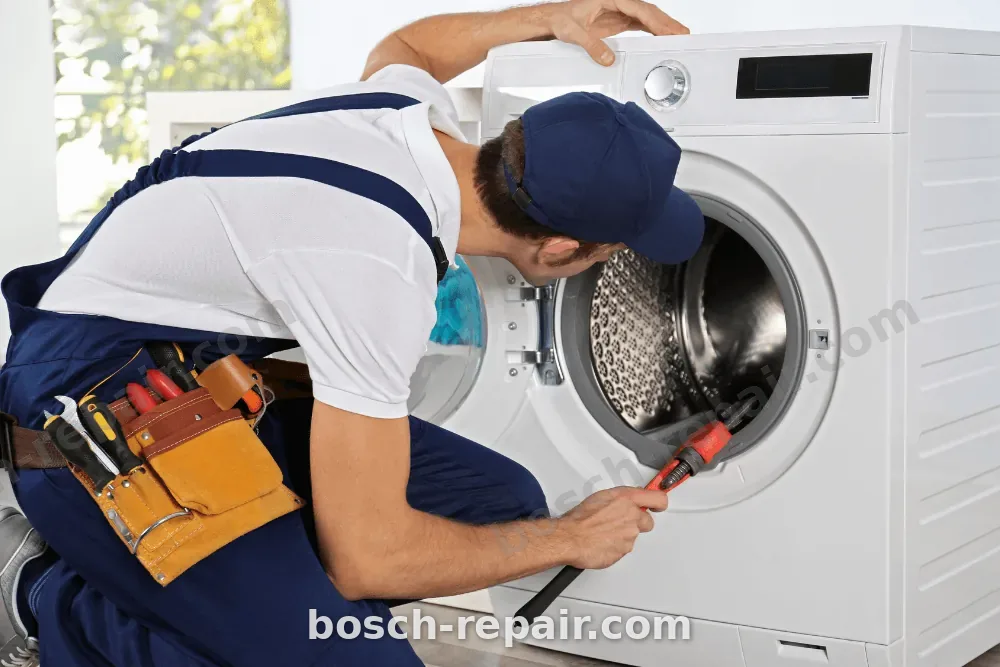
Bosch Washing Machine Repair in Dubai
If your Bosch washing machine will not drain, fill, heat, spin or start, a technician can usually diagnose it at your home within an hour of arriving and give you a fixed price in AED before any work begins. Book before 4 pm and most areas of Dubai get a visit the same day. Most faults trace back to one of eight symptoms, and this page walks through each: what causes it, what you can safely check yourself, and when to stop and message us.
We are an independent Bosch appliance repair company, not the manufacturer. If your machine is still inside Bosch's warranty, contact Bosch first; our independent service center page explains how to decide.
At a glance
- Inspection and written quote: AED 99, deducted from the repair if you go ahead
- Typical repair ranges: AED 150 to 780, excluding 5% VAT
- Warranty: 90 days on parts and labour for the repaired fault
- Hours: every day, 7 am to 10 pm, by WhatsApp or online booking
What we repair and which models
We repair front-loading Bosch washing machines and washer-dryers in homes across Dubai. That covers the Serie 2, 4, 6 and 8 ranges, built-in and integrated models, and the versions with i-DOS dosing and Home Connect. If you own a top-loading Bosch, tell us the model number when you book and we will confirm that we can support it.
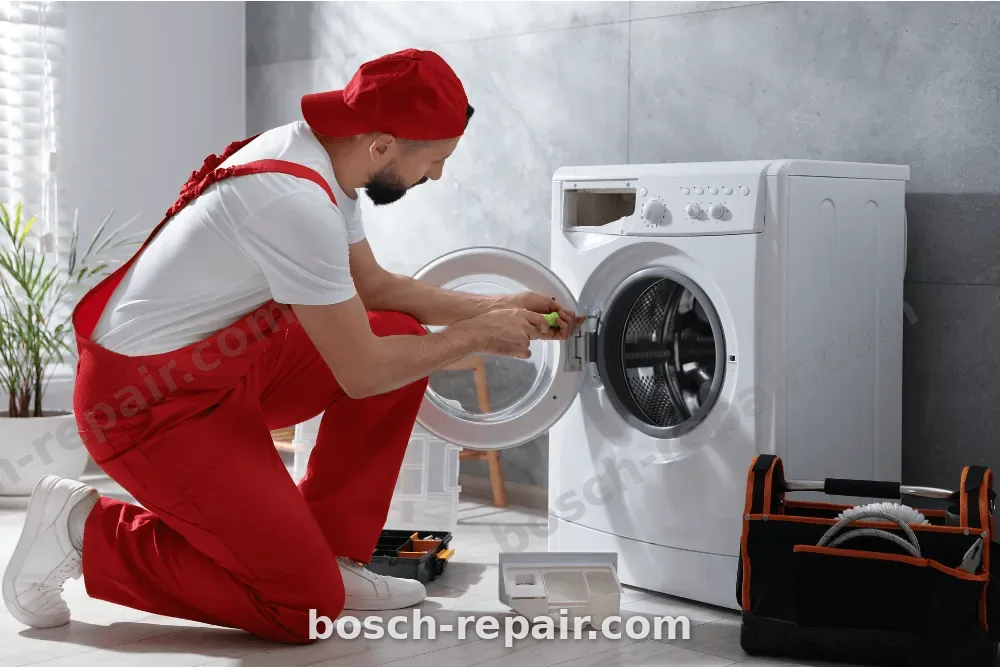
The series number tells you the feature level, not which parts are inside. Two Serie 4 machines with different model numbers can use different pumps, door locks and control modules. The number that matters is the E-Nr on the rating plate, which sits inside the door opening or on the back panel. Photograph it before you call. With it, a technician can check part availability before the visit, which is the difference between a one-visit repair and a two-visit one. Our guide to Bosch model numbers explains what the letters and digits do and do not tell you.
Find your fault
Start with what the machine is doing, not with the error code. Codes are useful, but a fault can occur without any code on the display, and the same symptom can produce different codes across Bosch ranges. Each section below gives the usual causes, one safe check, the sign that you should stop, and what happens when you message us.
One rule applies to all of them: if there is water on the floor near the plug, a burning smell, or the power trips every time you start the machine, switch the machine off at the wall, close the tap and message us. Do not try another cycle.
The machine will not drain
Water stays in the drum after the cycle, the display shows E18 (or F18 on some models), and the door stays locked. This is the most common Bosch washing machine fault.
The usual cause is a blocked pump filter, and our guide to how to clean the filter explains which filter that is and how to open it. Coins, hair grips, buttons, loose bra underwires, lint and the small socks that vanish from every household collect behind the service flap at the bottom front of the machine. The second cause is the drain hose: a kink behind the machine, or a hose pushed too far into a standpipe so that it siphons or seals. The third is a failed pump, which either hums without moving water or stays silent.
Bosch's own instructions for this fault are worth following exactly, because the dangers are real. Close the tap, switch the machine off and unplug it. Let the water cool, because the water in the drum can scald. Open the service flap, pull the small drain hose from its holder, remove its cap and let the water run into a container. Only then unscrew the pump cover, carefully, since more water may follow. Clean the cover, its thread and the pump housing, check that the impeller (the small fan inside) turns freely, refit the cover tightly with the grip vertical, and run a drain program.
Stop and message us if the filter is clean, the hose is straight and the machine still reports E18, or if the impeller is cracked or will not turn. At that point the pump needs replacing. Expect that job in the AED 150 to 320 range, finished in 45 to 90 minutes. Our drain pump replacement guide explains how to tell a failed pump from a blocked one and why the part depends on the model code.
The machine will not fill, or fills slowly
The drum stays dry or takes minutes to fill, the cycle pauses at the start, and the display shows E17 (or F17 on some models).
Check the tap first: fully open, and the inlet hose not kinked or squashed behind the machine. Then look at the water pressure. If the tap runs weakly with the machine disconnected, low supply pressure is the cause, and the machine will time out waiting to fill. Next comes the inlet filter, a small mesh screen where the hose screws into the machine, and a second screen in the tap-end of the hose. Limescale and fine sediment clog these quickly. With the water off and the hose disconnected, pull the mesh out with pliers, rinse it, and refit it.
Bosch inlet hoses on many models carry an AquaStop valve in a plastic block near the tap. Do not cut the hose, immerse the block in water or strip it open. If the valve has stuck, replace the whole hose.
Message us when the screens are clean, the tap is fully open and the code returns. That points to the inlet valve inside the machine, which is usually a short job. Typical range: AED 160 to 300.
The machine will not heat
Clothes come out cold, sheets do not dry as well as they used to, detergent residue stays in the fabric, or cycles run long as the machine waits to reach temperature. Bosch's pages describe E19 (or F19) as heating time exceeded, and our E19 guide covers it.
The element is a coil in the bottom of the drum housing. It scales up over time, then fails when scale insulates it from the water. A failed temperature sensor produces the same result, because the machine never believes it has reached the target. Cold washes still work, so many households only notice when a 60°C towel wash comes out lukewarm.
There is no safe DIY check. The element and sensor sit behind the outer drum and carry mains voltage. Bosch UK and Singapore name limescale on the element as a cause of reduced heating; our descaling guide gives their steps. A descale does not repair a failed element. Message us on WhatsApp and we test the element's resistance and the sensor reading on site. A replacement element typically falls between AED 260 and 480, including labour.
The machine leaks
Before you spend anything, find where the water comes from. Dry the floor and the back and bottom of the machine. Put a few paper towels under the front, back and sides. Run a short cycle and check which towel gets wet and when.
Water at the front at the door is almost always the door seal: a tear, a trapped hair clip, or mould that has eaten through the rubber. Our door seal replacement guide shows the checks to run first and how to tell cleaning from replacing. Water from the detergent drawer means overflow, usually from too much detergent foam or a blocked drain. Water at the back means a hose connection or the inlet valve. Water under the middle, especially after you cleaned the pump filter, is most often the filter cap or pump cover not refitted tightly. Water leaking from the bottom during spin points to the pump housing or the tub seal.
Stop using the machine for any leak you cannot trace to a loose connection you have fixed yourself. Water reaching the control module or the wiring turns a cheap repair into an expensive one, and it is a safety risk. Typical repair range for seals, hoses and pump housings: AED 180 to 380.
Loud noise, violent shaking or no spin
Noise and spin problems have different causes that overlap.
Start with the cheap ones. On a machine that was just installed or moved, check the back for transport bolts, the four long bolts that lock the drum for shipping. Bosch UAE says to remove them immediately if they are still fitted. Check that all four feet are level and the lock nuts are tight. Check the drum for coins or underwire in the pockets of jackets, which rattle and jam. Heavy items such as duvets and towels bunch up; Bosch machines detect an unbalanced load and stop or slow the spin to protect themselves, so redistribute the load and run the spin again.
If none of that applies, bearings are a reasonable suspect. Bosch US says loud grinding or knocking that continues may point to worn drum bearings or suspension problems, and our drum bearing guide sets out what Bosch's noise pages say. A rumbling that grows louder as the drum speeds up, or a drum that moves a lot when you rock it by hand with the door open, is worth telling the technician. On older Bosch models with a brushed motor, a drum that will not spin or a machine that stops mid-spin can also be worn carbon brushes. Newer machines with the EcoSilence Drive motor have no brushes, so the suspects shift to motor wiring, the control module or the bearings. Our carbon brushes and motor guide shows how to check which motor you have. F21 is reported by repair sites as a motor fault, though Bosch's own error pages that we read do not list it. Our F21 guide sets out what each source says.
Bearings and motors are the most expensive washing machine repairs, and the tub often has to come apart. Typical range: AED 220 to 520 for spin faults, up to AED 780 for bearings.
The door will not open
Do not force the handle. The latch is plastic, and a broken door lock is a bigger bill than the original fault. Bosch UK and Singapore list the child lock, trapped clothes, an overloaded drum and a faulty lock as the causes; our door lock guide sets out their steps.
First, check whether the machine is waiting. A lock releases a short time after the cycle ends, and not at all if there is water in the drum. If the machine did not drain (see above), the door stays locked by design. If the child lock is on (on most Bosch panels, hold the key symbol for a few seconds to release it), the door stays shut. After a power cut, the lock releases once power returns and the machine completes a short drain.
If the drum is empty, the cycle has finished and the child lock is off, the lock actuator has probably failed. Message us on WhatsApp. We release the door safely and replace the lock if needed. Typical range: AED 160 to 340.
The machine will not start
Nothing happens when you press start, the display is blank, or the display flashes and the program will not begin.
Work through the short list. Check the door closes with a click and that nothing, such as a sock or a strap, is caught in the seal. Check the child lock symbol is off. Our reset guide shows how to release it. Check the socket works with another appliance, and that the RCD (the trip switch on your board) has not tripped. If the machine has a delayed start set, it may simply be waiting. Switch off at the wall for two minutes and try again.
If the machine is dead on a working socket, or the RCD trips every time you press start, stop. A tripping RCD usually means water has reached the heater or wiring, and running it again is a hazard. A blank display on a good socket usually means the control module or a door-lock circuit. Our Bosch washing machine control board guide sets out what Bosch's pages check first. Typical range for control module repairs: AED 250 to 650.
The machine smells
A sour or musty smell from the drum or the drawer is biofilm: a layer of detergent residue, skin cells and bacteria that builds up in the seal, the drawer and the filter, especially with liquid detergents and low-temperature washes. It is not a fault, but it is a maintenance warning.
Wipe the door seal, including the folds at the bottom. Pull out the detergent drawer and wash it. Clean the pump filter. Run an empty hot cycle with a Bosch washing machine cleaner (see our descaling guide), and leave the door and drawer open between washes. If the smell is more like rotten eggs, the problem is often the drain, not the machine: a dry U-bend or a blocked standpipe lets sewer smells back up. If it persists after all of that, the drain hose or the pump housing may hold stale water, and a visit will find it.
Bosch washing machine error codes
An error code tells you which circuit the machine is worried about, not which part has failed. Treat it as a starting point. The table below lists the codes we see on Bosch washing machines most often, what they usually point to, a check that is safe for you to do, and when to call.
| Code | What it usually points to | A safe check | Message us when |
|---|---|---|---|
| E17 (F17 on some models) | Water not entering the drum in time | Tap open, inlet hose straight, inlet filters rinsed | Filters are clean and the code returns |
| E18 (F18 on some models) | Water not leaving the drum in time | Pump filter and drain hose, following Bosch's steps above | Filter and hose are clear, or the pump is silent or humming |
| E19 (F19 on some models) | Bosch pages: heating time exceeded; cannot be fixed by the owner. See our E19 guide | None | Always |
| F21 | Reported by repair sites as a motor fault. Not listed on the Bosch pages we read | Redistribute the load, restart once | The drum will not spin or stops mid-spin |
| E67 | Repair sites link it to the electronic control module. Not listed on the Bosch pages we read | Switch off at the wall for two minutes, then restart | The code returns after the restart |
Bosch publishes the official meaning of each code for each range on its own support pages, and the manual for your exact model is the final word. Some ranges show an E, some an F, and some show a code that does not appear in this table. We cover the most common ones in our error code library, including E17, E18 and F21. If your display shows something else, send us a photo of it.
Two habits help whatever the code. Write down the code and when it appeared in the cycle (filling, washing, draining, spinning), because that narrows the cause faster than the code does. And do not keep restarting a machine that stops on the same code; each restart adds wear to a failing part.
What a Bosch washing machine repair costs in Dubai
The AED 99 inspection includes the visit, the diagnosis and a written quote. If you approve the repair, the AED 99 comes off the repair price. If you decline, it is all you pay. The table shows typical prices by fault, all excluding 5% VAT.
| Fault | Usual cause | Typical fix | Time on site | Price (AED) |
|---|---|---|---|---|
| Not draining | Blocked pump filter, failed drain pump | Clear filter, replace pump | 45 to 90 min | 150 – 320 |
| Not filling | Inlet filter, inlet valve | Clean filter, replace valve | 45 to 90 min | 160 – 300 |
| Not heating | Scaled or burned-out element, temperature sensor | Replace element or sensor | 60 to 120 min | 260 – 480 |
| Leaking | Worn door seal, loose or split hose, pump housing | Replace seal, hose or housing | 45 to 90 min | 180 – 380 |
| Not spinning (see the carbon brushes and motor guide) | Worn motor brushes (older models), belt, imbalance sensor, motor wiring | Replace the failed part | 60 to 120 min | 220 – 520 |
| Won't start. See our door lock guide | Door lock module, control board | Replace lock or repair board | 60 to 120 min | 250 – 650 |
| Door won't open | Lock actuator, blocked drain | Release door, replace actuator | 45 to 90 min | 160 – 340 |
| Noisy drum. See our bearing guide | Worn bearings, shock absorbers | Replace bearings or dampers | 2 to 4 hours | 380 – 780 |
| Control module fault (see our control board guide) | Failed electronics | Repair or replace module | 60 to 150 min | 320 – 750 |
Three things move a quote within its range. The part itself matters most: a drain pump costs far less than a control module. Access matters too, since an integrated machine behind a cabinet door takes longer to pull out. And stock: if the part is not on the van, the price is the same but you pay for a second visit in time.
A worked example: your Bosch leaks from the front, and the technician finds a torn door seal. The all-in price is AED 280, and the AED 99 inspection is included in that figure. VAT adds AED 14, so you pay AED 294. If you decline the quote and keep using the seal, you pay AED 99 plus AED 4.95 VAT, a total of AED 103.95.
Payment is by card, cash or bank transfer, and every visit gets a VAT invoice with the part numbers listed.
Repair or replace?
Compare the written quote with the price of a comparable new machine. A workable rule: if the repair costs more than about half of a new equivalent, or if the machine is past ten years old and has had two serious faults, replace it. Below that line, repair usually makes sense.
Age matters more than price alone, because the second fault tends to follow the first. The examples below use assumed new-machine prices for the arithmetic, so check current prices before you decide.
- Three-year-old Serie 6, control module fault, quote AED 700. A comparable new machine at about AED 2,500 puts the repair at 28%. The machine is young. Repair it.
- Nine-year-old Serie 4, worn drum bearings, quote AED 680. A new machine at about AED 2,200 puts the repair at 31%, but bearing work signals general wear. If the rest of the machine is sound and the seal and pump are good, repair it. If the seal is also split or the pump is noisy, the next bill is close, so replace it.
- Eleven-year-old machine with failing bearings and a weak motor, combined quote AED 1,100. Against about AED 2,200 new, that is 50% of the price on an old machine with two serious faults. Replace it.
We will tell you when a repair is not worth it. If the quote tells you to buy new, you owe only the inspection fee.
Models and features that change the repair
Bosch markets its washing machines by series and by named features. A few of those features change what a technician checks.
| Feature | What it is | What it changes in a repair |
|---|---|---|
| EcoSilence Drive | Bosch's brushless motor, on selected models | No carbon brushes to wear. Motor faults point to wiring, the control module or bearings |
| AquaStop | Leak protection on the inlet hose and in the base, on selected models | If the machine stops with a leak warning, find the cause before using it again |
| i-DOS | Automatic liquid detergent dosing, on selected models | An extra tank and pump. Wrong detergent or a blocked dosing line causes faults; follow the manual's detergent guidance |
| Home Connect | A Wi-Fi module and app, on selected models | Connection problems are usually the router or the app. We check the module only if the machine also misbehaves |
| Heat-pump or condenser drying | Found on Bosch washer-dryers | Drying faults come from the heater, sensors or a clogged condenser, not the wash side |
The series number (2, 4, 6 or 8) tells you the feature level, not the parts list. Always use the E-Nr when ordering a part or asking for a quote. A Serie 4 machine and a Serie 6 machine can share a pump; two Serie 4 machines can differ.
Washer-dryers: faults that belong to the drying side
A Bosch washer-dryer has two jobs in one drum, and a fault can sit on either side. Work out which before you book, because it changes what the technician brings.
If the wash is fine but clothes come out damp after a dry cycle, the cause is usually one of three things. The first is load size: a washer-dryer dries noticeably less than it washes (one Bosch Serie 6 washer dryer lists 10 kg for washing and 6 kg for drying), so a full drum of towels will never come out dry. Our washer dryer guide covers drying faults in full. The second is lint. Washer-dryers that use a condenser collect lint in a filter or a condenser unit, and a clogged one stops moisture leaving the drum. Clean the lint filter after every dry cycle and check the manual for where the condenser sits on your model. The third is a drying heater or sensor fault, which needs a technician.
If the drying cycle ends early or runs for hours, the moisture sensor may be coated in detergent residue or limescale. Wipe the metal sensor strips inside the drum opening with a cloth dampened with white vinegar, then rinse. If the problem continues, say so when you book.
A washer-dryer that washes but never dries, or the reverse, is not a sign that the whole machine is failing. Tell us which half works.
What to tell us when you book
The more precise the booking, the more likely the first visit ends in a finished repair. Have these ready:
- The E-Nr from the rating plate. A photo is enough.
- The symptom, in your own words. "It stops with water in the drum" is more useful than "it's broken".
- The code, if any, and when it appeared. Filling, washing, draining or spinning.
- What changed. A new detergent, a power cut, a house move, a water shutdown in the building, a load of towels or a duvet.
- What you have already tried. If you cleaned the pump filter, say so, and say what you found in it.
- How old the machine is and whether it has been repaired before. This affects the repair-or-replace advice.
- Where it is. A stacked or integrated machine behind a cabinet door takes longer to pull out, and the technician needs to know before arriving.
- Access details. Building name, apartment, parking, and any approval your building management needs for technicians.
If you have a video of the fault, such as the noise when it spins or the water on the floor, send it by WhatsApp. A ten-second clip often settles the diagnosis before the visit.
Washing machine service: what it is and when you need it
"Service" and "repair" are different jobs. A repair fixes a fault. A service checks a working machine and prevents the faults that come from wear and scale. Bosch washers have no fixed service interval like a car, so what you need depends on how hard the machine works and how hard your water is.
If your machine is working but you want a check, the AED 99 inspection does the job. The technician examines the door seal, hoses and connections, the pump filter and drain, the detergent drawer and the heater, runs a test cycle, tells you what is wearing, and quotes any repair that needs doing. You decide what to approve.
You can also do the useful parts yourself in about ten minutes. Unplug the machine. Open the service flap and clean the pump filter, with a tray under it. Pull out the detergent drawer and wash it. Wipe the door seal and remove anything caught in the folds. Check the inlet hose and the drain hose for kinks. Check the machine is level, pressing diagonally on the top corners to make sure it does not rock. Then run an empty hot cycle with a descaler or washing machine cleaner.
The habits that matter most are the cheap ones:
- Measure the detergent, and see our guide to where detergent goes and how much to use. Too much foams, leaves residue and feeds the biofilm that makes machines smell.
- Do not overload. You should be able to fit a hand's width between the clothes and the top of the drum.
- Leave the door and drawer open between washes so the seal dries.
- Run a hot wash now and then. A steady diet of 30°C washes feeds residue buildup.
- Do not wash trainers or bulky duvets unless the manual says the machine is rated for them.
For a longer schedule covering every Bosch appliance, see the maintenance table on our Bosch service center page.
How a visit works and the warranty
You book online or by WhatsApp. We confirm a two-hour window, and the technician messages you on WhatsApp 30 minutes before arriving. On site, they diagnose the fault, show you the failed part where possible, and give you a written quote with the part number. You approve or decline. If you approve, the repair is done on that visit when the part is on the van; if the part has to be ordered, you get the lead time before you say yes. We test the machine before we leave, and you receive a VAT invoice with the warranty end date.
Every repair carries a 90-day warranty on the parts fitted and the labour for the repaired fault. If the same fault returns inside 90 days, we come back at no charge. We do not describe our parts as original Bosch. The part number is on your invoice, and our spare parts guide shows how to check it. The full process and what we do not cover are on the Bosch service center page.
Areas we cover
We repair Bosch washing machines across Dubai, with typical arrival times of 50 to 75 minutes after the technician sets off. Areas include Dubai Marina, JLT, Downtown Dubai, Business Bay, Palm Jumeirah, JVC, Dubai Hills, Mirdif and Al Barsha. If your area is not listed, message us on WhatsApp and we will tell you before you book. In towers and gated communities, send the building and apartment details with your booking so the technician is on the access list.
Frequently asked questions
How much does it cost to repair a Bosch washing machine in Dubai?
Most repairs fall between AED 150 and 780, excluding 5% VAT. A blocked filter or hose costs the least, and bearings, motors and control modules the most. The AED 99 inspection is deducted from the repair if you go ahead, and the quote is fixed before work starts.
Is it worth repairing a Bosch washing machine?
Usually, if the machine is under about ten years old and the repair costs less than half of a new equivalent. Drain pumps, door seals, inlet valves and heating elements are routine, affordable repairs. Bearings, motors and control modules deserve a closer look at the machine's age and condition.
Can you repair it the same day?
Book before 4 pm and in most areas we visit the same day. If the part is on the van, the repair is finished in that visit. If it has to be ordered, we give you the lead time first.
Do you carry parts for my model?
We carry the common parts for popular Bosch models: pumps, door seals, inlet valves and heaters. Model-specific parts, such as control modules and door locks, are ordered once the fault is confirmed. Send the E-Nr before the visit and we check availability in advance.
I cleaned the filter, but E18 is still on the display. Why?
The code can stay until a cycle completes, so run a drain program first. If it returns, check the drain hose behind the machine for a kink and the standpipe for a blockage. Make sure the pump cover is screwed in tightly with the grip vertical. If all of that is fine, the pump itself has failed, and it needs replacing.
Can I keep using the machine until the technician arrives?
If the fault is a slow drain or a noisy but working machine, short cycles may be safe. Stop completely if there is a leak, a burning smell, a tripping RCD, or a code you cannot explain. Running a machine with a leak or an electrical fault turns a modest repair into an expensive one.
How do I find my model number?
Look for the rating plate inside the door opening or on the back panel. The model number is the E-Nr, and the production code is the FD number. Photograph the plate and send it with your booking.
Do you repair Bosch washing machines bought outside the UAE?
Often, yes. Models sold abroad may have different voltages, plugs or part codes. Send the E-Nr and we confirm that parts are available before you pay for a visit.
Will a repair affect my Bosch warranty?
That depends on your warranty terms, and we cannot read them for you. If your machine is still in Bosch's warranty period, call Bosch first. If the warranty has ended, there is nothing to affect, and our 90-day warranty covers the repair we make.
Book a repair
Tell us the model, the symptom and any code on the display, and we confirm a time window by message. Send us a WhatsApp message with a photo of the fault and the rating plate, or use the online booking form. Prices shown exclude 5% VAT.
Independent Bosch appliance repair specialists. Not affiliated with BSH.