How to Clean a Bosch Washing Machine Filter: Which One, How Often, How to Open It
A Bosch washing machine has more than one filter, and the searches for "how to clean the filter" are about at least two of them. One is behind a small flap at the bottom front and catches coins, lint and buttons before they reach the drain pump. The others sit in the water inlet, at the tap end of the hose and on some models at the back of the machine, and catch grit before it reaches the inlet valve. They are cleaned differently, they fail in different ways, and cleaning the wrong one fixes nothing.
This guide sorts out which filter is which, when each needs cleaning, what Bosch's pages say about opening the flap and removing the filter, and what none of them says. Every step comes from a Bosch page, and we give the country with each one. Bosch UAE has a page on the filter, and we start there. The other pages are from the UK, Egypt, Malaysia and Singapore.
We keep one boundary. The full drain procedure, with the hose, the siphon and the test drain, is in our E18 guide, and the inlet filter fault steps are in our E17 guide. This page covers the routine job and the questions those guides do not answer: which filter, how often, how the flap and cap open, and what to do when something will not budge.
We are an independent Bosch appliance repair company, not the manufacturer, and we are not an authorised Bosch agent. If your washing machine is inside Bosch's warranty, contact Bosch first. For faults and prices, see our Bosch washing machine repair page.
At a glance
- The drain filter is the "fluff filter" behind the pump cover, reached through the service flap at the bottom front. Bosch UAE's steps: unplug, open the flap, drain the water, unscrew the pump cover, remove the fluff filter, check the pump for foreign objects.
- The inlet filters are at the tap end of the supply hose and, on some models, at the back of the machine. They are a different job, and our E17 guide has the steps.
- When to clean the drain filter: Bosch UK says a clogged filter can cause vibration and loud noise, longer cycles, random stops mid-cycle and laundry that comes out too wet. A drain code is not required.
- How often: none of the Bosch pages we read gives an interval for the filter. Our rule is further down and is labelled as ours.
- Series: no Bosch page gives separate steps for Serie 4 and Serie 6. The booklet for your model code is the document to follow.
- Stop and message us if: the impeller will not turn, the cap or cover will not come off, or the machine leaks after you refit it. Bosch UAE gives +971 600 522 553 for a jammed impeller.
Which filter do you mean?
Bosch's pages use "filter" for the part behind the pump cover and call it the fluff filter. Owners use "filter" for that part, for the inlet screens, and sometimes for the detergent drawer. This section separates them.
The drain filter, also called the pump filter or fluff filter
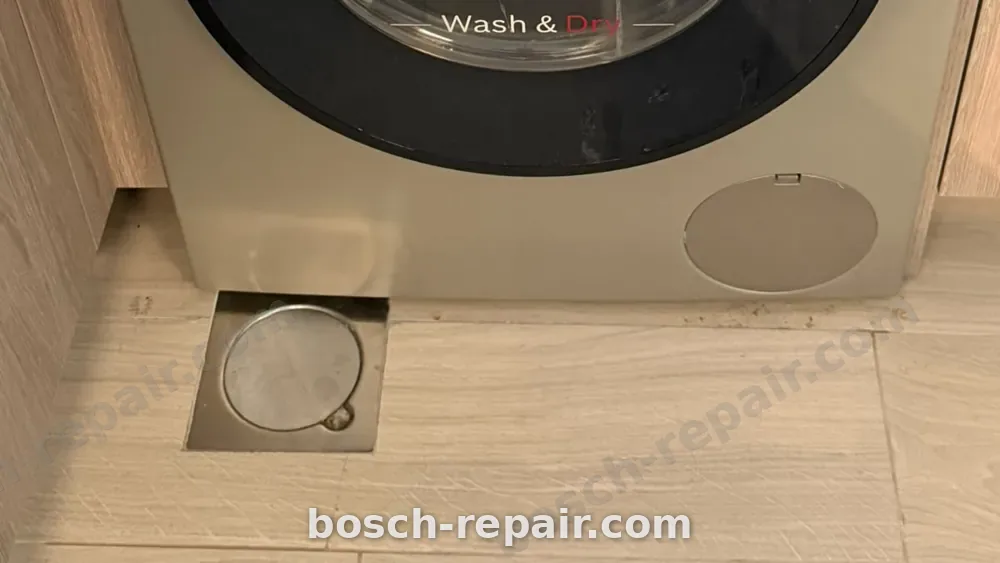
Bosch UAE's page on cleaning the filter calls it the "fluff filter" in the pump. Bosch UK says it sits behind a pump cover on a front-loading machine and catches debris before it reaches the drain pump. The UK page does not use the term drain pump filter. Bosch Egypt calls the job cleaning the drain pump, and its text says to unscrew the pump cover and check the pump.
So four names point at one place: fluff filter, pump filter, drain filter and pump cover. In our guides, when we write "the pump cover" we mean the part you unscrew, and "the filter" the part that comes out with it. Your machine may differ, and the booklet shows how.
You reach it through the service flap. Our E18 guide describes the flap as a small panel at the bottom front of the machine. None of the Bosch pages we read says where the flap is.
The inlet filters
Water enters the machine through a hose from the tap. Bosch's pages for a machine that does not fill describe a filter in the end of that hose, and Bosch Singapore adds a second one on the rear of the appliance for standard and Aqua secure models, which it says to remove with pliers. Bosch UAE says to rinse the hose-end filter under running water and use a small brush if needed. Our E17 guide sets out the steps with the safety notes.
These filters block with what travels in the water. They are not the part that catches coins and lint, and they do not make the machine fail to drain.
The detergent drawer
The drawer is not a filter, but it comes up in searches because it is the other part you pull out and clean. Bosch UAE says to clean it about every two months, which it says avoids unpleasant odours and bacteria. The routine section below covers it.
Which one for which symptom
| Symptom | Likely filter | Where to go |
|---|---|---|
| Water left in the drum, drain code | Drain filter and pump | Our E18 guide |
| Slow to fill, fill code, a low water supply | Inlet filters | Our E17 guide |
| Vibration, noise, long cycles, wet laundry, no code | Drain filter, per Bosch UK | This page |
| Musty smell | Seal, drawer, drum, and the drain filter among them | Our washing machine page and the door seal guide |
Do you need to clean it now?
Bosch UK gives the clearest answer of the pages we read, and it does not need a code.
What Bosch UK says a clogged filter can cause
- Vibration and loud noise.
- Longer cycles.
- Random stops mid-cycle.
- Laundry that comes out too wet.
The page adds that "simple cleaning and maintenance of the filter can solve or prevent many minor washing machine faults". It does not say how often, and it does not say how common each symptom is.
Reading that list
The first two are the ones worth noticing. A machine that has become noisier or slower and has no code is a machine that may only need its filter cleaned. Our reading is that a short list like this is a reason to check the filter before you call anyone, since the check costs ten minutes and a tray. But the list is Bosch's, and each symptom has other causes, so a clean filter that leaves the symptom unchanged means the fault is elsewhere.
With a code
A drain fault is covered in our E18 guide. E18 is a timeout: the machine asked for the water to leave and it did not. If the display shows it, the filter is the first place to look, and the guide takes you through it in order, with the water, the hose and the siphon.
Without a code and without symptoms
Nothing forces you to clean it. Bosch UK says it can prevent faults, which is the argument for a routine. The next section covers how often.
How often: Bosch gives no filter interval
We checked the Bosch pages from the UAE, UK, Egypt, Malaysia and Singapore. None gives an interval for the drain filter.
- Bosch UAE does not say how often.
- Bosch UK says to clean it when problems occur or as maintenance.
- Bosch Egypt, Malaysia and Singapore do not say.
The one dated interval Bosch UAE gives
Bosch UAE's pages on a washing machine that smells give one: a Bosch washing machine cleaner, part 00311927, 200 g, one application, every 3 months. A pack of four is 00311930, and the page says to order through an Authorized Service Center. That is a drum and tube cleaner, not a filter job, but it gives a rhythm the filter can share. The pages also say to wash at 60 °C or higher and to use the right amount of detergent.
Our rule
This is our suggestion, not Bosch's. The honest basis is that a filter fills with what goes into the machine, so the interval follows the household.
- Look at the drain filter about every two to three months, on the same day you run the Bosch cleaner. That pairs a Bosch interval with a check.
- Clean it whenever it holds anything. A coin, a button, a hair grip or a mat of lint means it is doing its job.
- Check it after a load that could have shed things: towels that shed fibres, a pocket you forgot to empty, or children's clothes with small parts.
- Check it at the first sign of Bosch UK's list: noise, long cycles, mid-cycle stops or wet laundry.
If the first two or three looks find nothing, lengthen the interval. If they find something every time, shorten it and look at what is getting into the machine.
Why the interval matters more in a family home
A machine washing for several people puts far more through its filter than one washing for a single person, and the household decides how often you need to look. We do not have a Bosch figure for it, and we do not make one up.
Opening it: where Bosch's pages differ
Searches for "how to open" and "how to remove" the filter are really searches for the details Bosch's pages leave out. Here is what each page says, side by side.
The pages compared
| Bosch page | How it reaches the filter | How it removes it |
|---|---|---|
| UAE | Open the service flap, drain the water through the pipe | "Unscrew the pump cover and remove the fluff filter" |
| UK | Unclip the pump cover to reach the black drain hose, pull the cap off the hose over a tray and drain | "Unscrew the filter cap anti-clockwise and slide it out" |
| Singapore | Open the service flap, let the water drain through the pipe | Unscrew the pump cover, remove the fluff filter |
| Malaysia | Open the service flap, let the water drain through the pipe | Unscrew the pump cover, remove the fluff filter |
| Egypt | Open the service flap, drain the water from the tube | Unscrew the pump cover, then check the pump |
What the differences are
The flap. Bosch UAE, Singapore, Malaysia and Egypt say "open the service flap". Bosch UK says "unclip the pump cover". These may describe two designs, or the same design in two wordings, and the pages do not say. Our E18 guide says to remove the flap, and notes that on some models the flap is a panel and on others it opens. We are not able to tell you which yours is.
The cover and the cap. Bosch UK separates two parts: a pump cover that unclips, and a filter cap that unscrews anticlockwise. The other four pages speak of a pump cover that unscrews. Our reading is that they are describing the same assembly. On the UK version, the cap is refitted to "the locked vertical position" and the cover clicks shut. Our E18 guide quotes Bosch as saying to tighten the pump cover firmly, and adds its own note that the grip should end up vertical.
The draining. Bosch UK says to pull the cap off the drain hose over a tray before you open the filter. The UAE, Singapore, Malaysia and Egypt pages say to drain the water through the pipe. These are the same step.
An oddity on three pages
Bosch UAE, Singapore and Malaysia all list "unscrew the water supply" as the second step, with a towel underneath. None says which hose that means. Bosch UK does not have the step and says to turn off the water supply, at the tap, in its first step. Do not take a hose off a machine with the tap open. Our suggestion is to close the tap, as Bosch UK says, and to check your booklet before touching an inlet hose.
Where each page stops
- None says where the service flap is.
- None says how a flap is released, if it is held by a clip.
- None says what tool, if any, opens it.
- None gives steps for a cover or cap that is stuck.
- None distinguishes one series from another.
We do not fill these gaps with methods of our own. Bosch UAE tells you to check the manual, and the booklet for your model is where the flap and the release are shown.
The series question
Three of the searches name a series: "Serie 4", "Serie 6", and a "Series 6 how to clean filter". No Bosch page we read gives steps by series, and the pages do not say which models they cover. Our Serie 4 and Serie 6 guides each list "clean the pump filter" as a maintenance item, with a tray under the service flap at the bottom front, so we treat the step as the same. Our Serie 2 guide points out that the Serie 2 manual we read (for the WAK2020SIR) describes a "detergent solution pump" and no separate drain filter, so a Serie 2 may not have the part the other pages describe.
The series name tells you the feature level, not the parts, as our washing machine page says. The E-Nr on the rating plate, and the booklet for that code, decide which design you have. Our model numbers guide explains how to read it.
The steps in brief
This is the sequence the Bosch pages agree on, set out so you can see where it ends and our E18 guide begins. Follow your booklet where it differs.
Before you start
- Switch off, unplug, and close the water tap. Bosch UAE, Singapore, Malaysia and Egypt all start with the power, and Bosch UK adds the water supply.
- Lay a towel on the floor and a tray on it. Bosch UK says to use a large tray or shallow container. Bosch UAE says a towel.
- Let hot water cool. Bosch US's drainage page warns that the water may scald, and our E18 guide covers it.
Opening and draining
- Open the service flap, or unclip the pump cover on the UK version.
- Drain the water. Through the small drain hose on the pages that describe one. Bosch UK says to pull its cap off over the tray, drain, replace the cap and return the hose to position, and to repeat if needed.
The filter
- Unscrew the pump cover or the filter cap. Anticlockwise, on the Bosch UK page. Water will spill onto the towel.
- Remove what you find. Bosch UK names coins, buttons and lint.
- Clean the filter thoroughly. The Bosch UK page does not name a method, and the other pages give none.
- Check that the impeller turns freely. Bosch UK and Bosch UAE both say so. If it does not, Bosch UAE says something may be jammed and to contact customer service.
Refitting
- Screw the cap back in firmly, to the locked vertical position on the UK page.
- Close the cover until it clicks. Bosch UK says so.
Beyond this page
The pages stop there. Our E18 guide covers the 1 litre leak test, the hose and siphon, and the emergency door release. We do not repeat them.
The inlet filters as a routine job
The inlet filters get their own section because owners seldom think of them until the machine is slow to fill. They are not on Bosch UK's pump-filter page, and they are covered under E17.
What Bosch says, briefly
Our E17 guide gives the procedure from Bosch Singapore and Bosch UAE in full. In short: switch off and disconnect the power, close the tap, remove the hose from the tap, rinse the filter in the hose end under running water with a small brush, and, on some models, remove the rear filter with pliers. Then reconnect the hoses and check for leaks.
How often
None of the Bosch pages gives an interval for the inlet filters either. Our suggestion is to look at the tap-end filter when you clean the drain filter, since both take only a few minutes. If you move house, or work is done on the pipes, look sooner. Our E17 guide notes that the first few weeks after plumbing work often produce debris, which is our own reading.
What not to touch
Many Bosch inlet hoses carry an AquaStop valve in a plastic block near the tap. Our E17 guide says to leave the block alone: do not cut the hose, immerse it or strip it open.
What you find, and what it tells you
The filter shows what has been going into the machine. This section is our reading, helped by what Bosch names.
- Coins, buttons and hair grips. Bosch UK names coins and buttons. They come from pockets and clothes, and the habit that stops them is checking pockets.
- Lint and fluff. Bosch UAE calls the part the fluff filter, which tells you what it is expected to hold. Some lint is normal. A thick mat means a lot of shedding fabric in the loads.
- Hair and threads. These wind round an impeller and slow it. Our E18 guide advises checking that the impeller turns after you clean.
- Underwires and small hard parts. Our washing machine page lists loose bra underwires among the things that collect there. A mesh bag for small items keeps them out of the pump, as our E18 guide says.
- Nothing. Good news, and a reason to lengthen the interval.
If you find a broken piece of plastic or a fragment of something that is not laundry, keep it and tell us. It may mean something inside the drum is breaking up. Our reading is that the piece is worth keeping because it tells the technician what to look for, and that is a suggestion, not a Bosch rule.
If it will not open, the impeller will not turn, or it leaks after
None of the Bosch pages covers a stuck cover or cap. Here is what they do cover, and what we suggest.
The impeller will not turn
Bosch UAE, Singapore and Malaysia say the same: if the impeller cannot be turned, something may be jammed in it, and you should contact customer service. Bosch Egypt's page tells you to test the impeller but we did not find the same instruction there. Bosch UAE's page gives +971 600 522 553 for this, and its general support number is BSH 048030400. Bosch Singapore gives +65 6751 5000 and Bosch Malaysia +603 7950 9338. Those are other countries' lines. Bosch Egypt's page has an unfilled placeholder where its number should be.
Do not force it. A stuck impeller can mean an object wedged behind it, or a pump that has failed. Our drain pump replacement guide explains how to tell the two apart.
The cover or the cap will not come off
No Bosch page we read says what to do. Our suggestion, and it is ours, is to stop and not to use a tool that the booklet does not name. Forcing a plastic thread can crack the cap or the housing, and a cracked housing leaks. Tell us the model code and what you tried, and we look at it on a visit. This is the one case in this guide where the AED 99 inspection is the cheapest way to find out.
It leaks after you refit it
Our E18 guide says a leak at the cover means the cover is loose or its thread is dirty. Bosch UK says to screw the cap in firmly to the locked vertical position and to close the cover until it clicks. If it still leaks, drain the machine again, clean the thread, and retighten. Our E18 guide describes the leak test.
The machine still will not drain
If the filter was the cause, the next wash drains. If it did not, the hose, the siphon or the pump are next, and our E18 guide goes through them. If the pump has failed, our washing machine overview puts the not-draining repair at AED 150 to 320, excluding 5% VAT, and our drain pump guide explains the part.
The rest of the monthly routine
The filter is one item on a short list. Here is what Bosch's pages say about the others, with the interval where one is given.
The detergent drawer
Bosch UAE says to clean it about every two months. Remove the drawer completely by operating the lock in the middle, soak it in a washbasin, and remove residue with a cloth or a small brush such as an old toothbrush. For stubborn deposits such as limescale, it names the Bosch washing machine cleaner, 00311927. It does not say how to refit the drawer.
Bosch UK says the drawers are self-cleaning, with jets that flush the chambers, so manual cleaning is only needed if you want to remove stubborn residue. It gives no schedule. The two pages differ in emphasis, and neither is wrong: the UAE page gives a routine, and the UK page says it is only needed when residue builds up.
The door seal
Bosch UK and Bosch Singapore say to wipe the seal, inside and out, with a damp clean cloth and then run a maintenance wash. Mould tends to develop in the folds. Our door seal guide covers when a seal needs cleaning and when it needs replacing.
The drum and the tubes
Bosch UAE's washing machine cleaner, 00311927, is the product for this: one application every 3 months, according to the page. The same pages say to wash at 60 °C or higher and to use the right amount of detergent.
Vinegar
Bosch UAE has a page titled as a question about cleaning a washing machine with vinegar, and its answer is no: vinegar is "not recommended because it causes too much damage to the rubber parts in the machine". It recommends Bosch's own cleaner instead. The page gives no vinegar method and no other home remedy. The washing machine seal is a rubber part, which is why we raise it here.
A monthly checklist
Taking Bosch's figures and our rule together, a routine looks like this. Everything but the drawer and the cleaner interval is our suggestion.
- Wipe the seal after the last wash of the day.
- Look at the drain filter every two to three months.
- Wash the detergent drawer about every two months, as Bosch UAE says.
- Run the Bosch washing machine cleaner every three months, as Bosch UAE says.
- Look at the tap-end inlet filter when you look at the drain filter.
- Run a wash at 60 °C or higher from time to time.
Mistakes the Bosch pages and our own guides warn against
Most filter jobs go wrong in the same few places, and each has a source behind it.
- Opening it while the water is hot. Bosch's manual, quoted in our E18 guide, says to let the water cool, and its US page notes the water may be hot. A drum that has just finished a hot wash can hold scalding water.
- Taking a hose off with the tap open. Bosch UAE, Singapore and Malaysia list "unscrew the water supply", and none says which hose. Close the tap first, as Bosch UK does.
- Forcing the cover. Our E18 guide says a cover forced onto a dirty thread leaks. If the cover or cap resists, stop and check the thread or the release in the booklet.
- Running a wash straight after a blockage. Our E18 guide says to do the leak test first. A cover that is slightly loose leaks onto the floor, and a wash is the worst time to find out.
- Tearing into the AquaStop block at the tap end of the hose. It is a safety part, and our E17 guide says to leave it alone.
- Going further in than the flap. Our suggestion is to stop at the pump cover. Removing panels or touching wiring is a technician's job.
What cleaning the filter cannot fix
A clean filter is a cheap first step and often enough, but it has limits, and it helps to know them before you spend an evening on it.
Bosch UK's list of symptoms has other causes. A noisy, shaking machine can be an unlevel machine or one that still has its transport bolts in, as our washing machine page explains. The filter is the cheapest suspect and the first to rule out, not the only one.
If the filter was clean, the impeller turned freely and the machine still will not drain, the next suspects are the hose, the siphon and the pump itself. Our E18 guide gives the order. Our washing machine overview puts the not-draining repair at AED 150 to 320 and the leak repairs (seal, hose, pump housing) at AED 180 to 380, both excluding 5% VAT. The pump guide shows how a technician decides between a clog and a failed part.
The sensible order is this: clean the filter, check the impeller, run the leak test, and only then decide whether to book. If you book, the inspection is AED 99 and is credited to the repair, and you will have saved the technician the first twenty minutes by telling us what you found.
What to tell us if you need a visit
- The model code from the rating plate, as a photo.
- What happened when you opened the flap: what came out, whether the cap or cover moved, and whether the impeller turns.
- What you saw before: vibration, noise, long cycles, stops, wet laundry, or a code.
- Whether water leaks after refitting, and where.
- What you found in the filter.
- Access: your building, apartment number and parking, and any approval your building needs. For a built-in machine, say whether a panel hides the controls.
A short video of the machine at the end of a cycle, with the flap open, helps. Send it by WhatsApp.
Frequently asked questions
How do I clean the filter on a Bosch washing machine?
Switch off, unplug and close the tap. Open the service flap, drain the water, unscrew the pump cover or filter cap, take out what you find, clean the filter, check the impeller turns, and refit firmly. Bosch UAE and UK give these steps, and our E18 guide has the hose and siphon.
Where is the filter on a Bosch washing machine?
Behind the pump cover, reached through the service flap at the bottom front. Bosch UAE calls it the fluff filter in the pump. The Bosch pages we read do not say where the flap is on your model, so check the booklet.
How do I open the filter on a Bosch washing machine?
Bosch UK says to unclip the pump cover, drain the hose, and unscrew the filter cap anticlockwise. Bosch UAE says to open the flap, drain the water and unscrew the pump cover. None says how a flap is released.
How do I remove the filter on a Bosch Serie 4 or Serie 6?
No Bosch page gives separate steps by series. Our Serie 4 and Serie 6 guides both say to open the filter behind the service flap. The booklet for your model code decides.
How do I clean the inlet filter on a Bosch washing machine?
It is in the tap end of the supply hose, and on some models at the rear. Close the tap, disconnect the hose, and rinse the filter under running water with a small brush. Our E17 guide has the steps.
How often should I clean a Bosch washing machine filter?
None of the Bosch pages we read gives an interval. Our rule is to look every two to three months and clean it whenever it holds anything. Bosch UAE gives one interval, for the Bosch washing machine cleaner: every 3 months.
What does a blocked washing machine filter do?
Bosch UK says it can cause vibration and loud noise, longer cycles, random stops mid-cycle and laundry that comes out too wet.
The filter cap will not unscrew. What should I do?
No Bosch page covers it. Our suggestion is to stop and not force it, because a cracked thread or housing leaks. Send us the model code and what you tried.
Can I clean the filter with vinegar?
Bosch UAE says vinegar is not recommended for the machine because it causes too much damage to the rubber parts. The pages we read give no vinegar method for the filter. None of them names a cleaning agent for the drain filter.
Does a Bosch Serie 2 have a drain filter?
Not necessarily. The Serie 2 manual we read describes a "detergent solution pump" and no separate drain filter. Check your booklet before you go looking for a flap.
My machine is under warranty. Should I still message you?
Contact Bosch first. Bosch UAE lists BSH 048030400 and +971 600 522 553 for large appliances. We are an independent repair company and not an authorised Bosch agent, and a repair by us may not be covered by the manufacturer's warranty terms.
Book a washing machine inspection or repair
Send us the model code from your rating plate, what you saw before and what you found in the filter. We confirm a time window and the price range before we set off. Send us a WhatsApp message with the photos, or use the online booking form. We repair Bosch washing machines across Dubai, with typical arrival times of 50 to 75 minutes after the technician sets off. Prices shown exclude 5% VAT.
Independent Bosch appliance repair specialists. Not affiliated with BSH.